Personal Locator Beacons for Fishing (2026)
PLB or EPIRB for fishing, what NOAA's free registration requires, battery life and flotation per maker, and four 406 MHz beacons sold by their maker's group.
Independently chosen. As an Amazon Associate I earn from qualifying purchases: if you buy through our links, we may earn a commission at no cost to you. How we research
Quick answer
For an angler who wants a beacon on the life jacket, the ACR ResQLink View RLS floats on its own, shows its status on a screen and confirms the alert was received. The ResQLink 410 RLS does the same without the screen. For the boat itself, an EPIRB such as the Ocean Signal EPIRB1 Pro.
In this guide
- Solo offshore and kayak anglersACR ResQLink View RLS Personal Locator BeaconFrom the listing · not tested
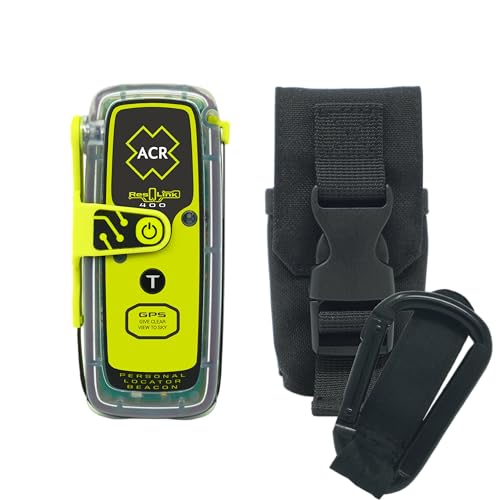
- Beacon plus a way to wear itACR ResQLink 400 PLB with Pouch and CarabinerFrom the listing · not tested



A PLB is the beacon you wear; an EPIRB belongs to the boat. Both send a 406 MHz distress signal to the same satellites, so the choice is about where the beacon lives and whether it can set itself off. Registration, testing and battery rules are the same for both, and they matter more than which brand you pick.
How we chose: we did not test these beacons; the specs come from ACR's and Ocean Signal's pages and the listings, all sold by ACR Electronics (Ocean Signal says it operates within the ACR group) and in stock on September 29, 2026.
Five beacons and a pouch
| Beacon | Type | Floats? (per maker) | Operating life | Battery | Sold by | Amazon price |
|---|---|---|---|---|---|---|
| ACR ResQLink View RLS | PLB, RLS, display | Yes, built in | 28 hours | 5 years | ACR Electronics | $529.95 (Amazon, as of Sep 29, 2026, 5:00 PM UTC)Check price |
| ACR ResQLink 410 RLS | PLB, RLS | Yes, built in | 24+ hours | 5 years | ACR Electronics | $464.95 (Amazon, as of Sep 29, 2026, 5:00 PM UTC)Check price |
| ACR ResQLink 400 bundle | PLB | Yes | 24+ hours | 5 years | ACR Electronics | $417.00 (Amazon, as of Sep 29, 2026, 5:01 PM UTC)Check price |
| Ocean Signal rescueME PLB1 | PLB | Only in the pouch | 24+ hours | 7 years | ACR Electronics | $399.95 (Amazon, as of Sep 29, 2026, 5:00 PM UTC)Check price |
| PLB1 Floatation Pouch | Pouch | Adds buoyancy | n/a | n/a | ACR Electronics | $24.99 (Amazon, as of Sep 29, 2026, 5:01 PM UTC)Check price |
| Ocean Signal EPIRB1 Pro | EPIRB, Category I | Designed to float | 48+ hours | 10 years | ACR Electronics | $789.95 (Amazon, as of Sep 29, 2026, 5:00 PM UTC)Check price |
Prices are Amazon's, as of the time shown, and subject to change. Details
ACR's figures are from its ResQLink View RLS, ResQLink 410 RLS and ResQLink 400 pages; the EPIRB figures are from its listing.
PLB or EPIRB
NOAA's 406 MHz beacon page sets out the difference. PLBs "can only be activated manually," and their "operational battery life once activated is 24 hours minimum." EPIRBs are for maritime use and transmit "for at least 48 hours once activated." A Category I EPIRB sits in a bracket with a hydrostatic release and deploys itself when a boat sinks to 3 to 10 feet; a Category II is manual only.
For most anglers that points one way: a PLB on the life jacket, because the person in the water is the one who needs finding. If you run your own boat offshore, the Coast Guard's federal requirements guide says to consider an EPIRB beyond the minimum equipment, along with communications gear and a life raft.
NOAA adds that a Category I EPIRB should be mounted outside the cabin where it can "float free" of a sinking boat, and a Category II kept in the most accessible spot aboard.

Registration: required, free, every two years
NOAA's registration page is plain about it: if you buy a new or used U.S.-coded 406 MHz beacon, "you MUST register it with NOAA as required by law." Its beacon page adds that registration "is free of charge." You do it online at the National Beacon Registration Database.
Registration lasts two years, and NOAA says you must re-register every two years and update it whenever your phone number, address or boat changes. If you sell the beacon, tell NOAA and tell the buyer to register it.
Why it matters: NOAA says registration lets rescuers call you to check whether an alert is real "before they initiate a search," and helps them find you faster because "they know who and what they are looking for." You'll need the beacon's 15-character hex ID, printed on the beacon and its box.
Floating, screens and Return Link Service
A PLB that sinks when you drop it is no use to a kayak angler. ACR says the ResQLink View RLS, 410 RLS and 400 all have built-in buoyancy. Ocean Signal's PLB1 page says the rescueME PLB1 floats only with its optional flotation pouch, and that "the PLB will not float in an operating position in the pouch," so it has to be lanyarded to you.
Return Link Service is the newer feature. NOAA says RLS gives an indication on the beacon that the signal "has been received and localized" and passed to authorities, but "does NOT mean that a rescue has yet been organized/launched." RLS beacons coded for the U.S. have been legal here since June 1, 2022.
Key point: wear the beacon, not the bag. A PLB clipped to a life jacket goes over the side with you; one in a dry bag stays on the boat.
Battery life and testing
Battery rules differ by maker. ACR says the battery must be replaced after 5 years or after emergency use, whichever comes first, and only by an ACR certified battery replacement center. Ocean Signal rates the PLB1's battery at seven years, replaceable at a battery replacement center. NOAA requires any 406 MHz beacon's battery to hold full charge for at least five years if not used or over-tested.
Test only with the built-in self-test. NOAA's testing page says live testing is not authorized without NOAA approval, and any activation other than self-test "is interpreted as a distress signal." If you set one off by accident, NOAA's FAQ says to call the Coast Guard at 1-855-406-USCG (8724).

Which one to buy
If you fish alone, from a kayak or offshore, start with the ResQLink View RLS: it floats, its screen shows what the beacon is doing, and RLS tells you the alert landed. The ResQLink 410 RLS does the same without the screen. The ResQLink 400 bundle drops RLS but comes with a pouch to wear it.
Pick the rescueME PLB1 if weight and size decide it, and buy the flotation pouch with it. For a boat you own and run offshore, an EPIRB such as the EPIRB1 Pro is registered to the boat and deploys itself.
The ResQLink AIS (PLB-450) adds an AIS signal nearby boats can see, but Amazon offered it only through a third-party seller when we checked.
Related: the engine cut-off switch rule that stops the boat when you go over, and inflatable vs foam life jackets to clip the beacon to.
The products in this guide
In the order this guide discusses them, from listings, certifications and standards. Where a price appears it is Amazon's, with the time it was read.
Solo offshore and kayak anglers
ACR ResQLink View RLS Personal Locator Beacon
From the listing · not testedBuy it if you want to see on the beacon that your alert went through.
Pros
- + Built-in buoyancy and a digital display that shows each stage of an activation, per ACR
- + Return Link Service confirms the distress signal was received
- + 28 hours of operating life and a 5-year battery, per ACR
Cons
- - Battery must be replaced by an ACR certified center after 5 years or after emergency use
Same RLS, no screen
ACR ResQLink 410 RLS Personal Locator Beacon
From the listing · not testedBuy it if you want RLS and flotation and can do without the screen.
Pros
- + Built-in buoyancy, visible and infrared strobes, per ACR
- + Return Link Service with GPS and Galileo positioning
- + 24+ hours of operating life and a 5-year battery
Cons
- - No display, so RLS confirmation comes from indicator lights instead of text
Beacon plus a way to wear it
ACR ResQLink 400 PLB with Pouch and Carabiner
From the listing · not testedBuy it if you want a floating ACR beacon and a pouch in one box.
Pros
- + 406 MHz with a 121.5 MHz homing signal, LED and infrared strobes, per the listing
- + Buoyant, 24+ hours of operation, 5-year battery, per ACR
- + Bundled pouch fits belts or life jacket straps
Cons
- - No Return Link Service and no display

Smallest beacon on a jacket
Ocean Signal rescueME PLB1
From the listing · not testedBuy it with the pouch if size matters most and you'll lanyard it to the jacket.
Pros
- + About 4 oz and 30% smaller than Ocean Signal's next smallest beacon, per the listing
- + 7-year battery and 24+ hours of operation, per Ocean Signal
- + Rated waterproof to 15 m by Ocean Signal
Cons
- - Floats only in the optional flotation pouch, and not in an operating position

PLB1 owners on the water
Ocean Signal rescueME PLB1 Floatation Pouch
From the listing · not testedBuy it with a PLB1 you'll carry on the water.
Pros
- + Adds buoyancy to the rescueME PLB1 when fitted, per the listing
- + Snug fit that keeps the PLB1 operational
Cons
- - Fits the PLB1 only; Ocean Signal says the beacon won't float in an operating position in it

The boat's own beacon
Ocean Signal rescueME EPIRB1 Pro
From the listing · not testedBuy it if you run your own boat offshore and want a beacon that deploys itself.
Pros
- + Category I auto-release beacon, per the listing
- + 10-year battery and 48+ hours of operation, per the listing
- + 66-channel GPS and an integrated lanyard
Cons
- - Registered to the vessel, so it doesn't go with you onto someone else's boat
Frequently Asked Questions
Does a PLB need a subscription?
No. The ACR and Ocean Signal listings say their PLBs need no subscription, and NOAA's beacon registration costs nothing.
Can I register a beacon bought overseas?
Only if it is coded for the U.S. NOAA's registration page says it accepts only beacons with U.S. country codes, including 366 to 369 for the contiguous states, 303 for Alaska and 338 for Hawaii. Others must be registered where they are coded.
Do satellites still hear old 121.5 MHz beacons?
No. NOAA says satellites have not detected 121.5 MHz signals since 2009. It also says every 406 MHz beacon carries a low-power analog homing signal so rescuers can close in once they are near.
How do I get rid of an old beacon?
NOAA's FAQ says to make it inoperable by removing the battery and, if possible, returning it to the maker, wrapped in tin foil if the battery is still in. Then update your registration so no one is sent looking for it.
Proof
Sources
Everything this guide relies on, as linked in the text. Last checked September 29, 2026.
- oceansignal.com: Ocean Signal says
- acrartex.com: ResQLink View RLS
- acrartex.com: ResQLink 410 RLS
- acrartex.com: ResQLink 400
- NOAA SARSAT: 406 MHz beacon page
- U.S. Coast Guard Boating Safety: Federal requirements guide
- NOAA SARSAT: Register your beacon
- National Oceanic and Atmospheric Administration: National Beacon Registration Database
- oceansignal.com: PLB1 page
- NOAA SARSAT: Emergency beacon testing
- NOAA SARSAT: FAQ
SaltProofLab is a participant in the Amazon Services LLC Associates Program, an affiliate advertising program designed to provide a means for sites to earn advertising fees by advertising and linking to Amazon.com.
Amazon prices and availability change often; cards with a live Amazon price show when it was last checked. As an Amazon Associate I earn from qualifying purchases.