Handheld Marine VHF Radios for Safety (2026)
Handheld marine VHF radios for fishing boats and kayaks: floating and water ratings as makers state them, DSC and the MMSI, the license rule, and channel 16.
Independently chosen. As an Amazon Associate I earn from qualifying purchases: if you buy through our links, we may earn a commission at no cost to you. How we research
Quick answer
For a handheld that floats and transmits at 6 watts, the Uniden Atlantis 275 or Cobra BlueBound 350. For a kayak, the smaller Uniden Atlantis 155. None of the DSC handhelds we found had a trusted seller in stock, so if you want a DSC distress button, the Uniden UM385 fixed-mount radio has one.
In this guide
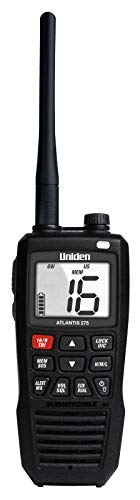


A handheld VHF is the radio you can take into the water with you. A fixed-mount radio at the helm has more power and range, but if the boat is swamped or you are drifting away from your kayak, the radio clipped to your life jacket is the one that works.
Four things decide whether a handheld is safety gear: will it float, how wet can it get, can it send a DSC distress alert, and can you use it legally.
How we chose: we did not test these radios. Picks come from the floating claims, water ratings and power stated on each listing, sold by Amazon.com and in stock on September 30, 2026.
Five marine radios side by side
| Radio | Floats (maker) | Water rating (maker) | Power | DSC | Sold by | Amazon price |
|---|---|---|---|---|---|---|
| Uniden Atlantis 275 | Yes | IPX8 / JIS8 | 6 W | No | Amazon.com | $108.99 (Amazon, as of Sep 29, 2026, 5:00 PM UTC)Check price |
| Cobra BlueBound 350 | Yes | IPX7 | 6 W | No | Amazon.com | $139.95 (Amazon, as of Sep 29, 2026, 5:01 PM UTC)Check price |
| Uniden Atlantis 155 | Yes | IPX8 / JIS8 | 3 W | No | Amazon.com | $67.99 (Amazon, as of Sep 29, 2026, 5:00 PM UTC)Check price |
| Uniden MHS75 | Yes | JIS8, 30 min at 5 ft | 5 W | No | Amazon.com | $89.99 (Amazon, as of Sep 29, 2026, 5:00 PM UTC)Check price |
| Uniden UM385 (fixed) | No | IPX4 | 25 W | Class D | Amazon.com | $107.99 (Amazon, as of Sep 29, 2026, 5:00 PM UTC)Check price |
Prices are Amazon's, as of the time shown, and subject to change. Details
Floating and water ratings, as the makers state them
A radio that sinks when it slips off the gunwale is gone. All four handhelds here are sold as floating: the Cobra listing describes a "high-visibility orange floating core," and Uniden says each Atlantis "floats."
Water ratings are codes from the IEC 60529 standard (IPX7, IPX8) and its Japanese counterpart (JIS8). The code alone doesn't give the depth for IPX8, so look for the maker's own figure. Of these, only Uniden's MHS75 listing states one: "submersible for up to 30 minutes at five feet." The UM385 is IPX4, which Uniden describes as resistant to "rain or splashing water."

Range: why a handheld is a backup, not the main radio
The Coast Guard's radio information for boaters says a VHF radio "is intended mainly for short range communications, generally 5-10 miles, and at least 20 miles to a USCG station."
The FCC's VHF handheld page makes the same point from the rescue side: a handheld-formatted MMSI tells responders about "your unit's limited power and range capabilities." For offshore trips, a handheld goes with a fixed-mount radio and a registered personal locator beacon, not instead of them.
Channel 16 and the watch rule
Channel 16 is the distress, safety and calling channel. The Coast Guard's radio page says "FCC regulations require boaters having VHF radios to maintain a watch on either VHF channel 9 or channel 16, whenever the radio is turned on and not communicating with another station," and that Mayday calls go out on 16.
That is what dual and triple watch are for. The Cobra's Tri-Watch monitors 9, 16 and a channel you pick; Uniden says the MHS75 checks 16 and 9 every 2 seconds while you listen to another channel, per the listings.
DSC and the MMSI
Digital Selective Calling lets a radio send a distress alert with the press of one button. It only works with a nine-digit MMSI programmed in. The FCC's MMSI page says that if your radio has DSC, "you must obtain a nine-digit maritime mobile service identity number, and have it programmed into the unit before you transmit."
For boats that don't need an FCC license, the same page says domestic MMSIs come from private registrants: BoatUS, the United States Power Squadrons and Shine Micro. It adds that domestic MMSIs "are not usable internationally." If you fish Bahamian or Canadian water, you need an FCC-issued one.
With GPS, DSC does more. The FCC says that in GPS-equipped DSC radios, the MMSI "enables Search and Rescue (SAR) teams to live track the location of mariners in distress." The Coast Guard's MMSI guidance warns that out-of-date registrations or missing positions make it harder to tell a real distress from an accidental alert.
Key point: none of the four handhelds here has DSC. The DSC handhelds we looked at, Uniden's MHS338BT and Standard Horizon's HX890, were either not in stock from Amazon.com or sold only by third parties when we checked, so they aren't linked. The fixed-mount UM385 has full Class D DSC, per Uniden.

Do you need a license?
For most recreational boats in U.S. waters, no. The Coast Guard's radio page states: "An FCC ship station radio license is no longer required for any vessel travelling in U.S. waters which uses a VHF marine radio, radar or EPIRB, and which is not required to carry radio equipment." The FCC's ship radio stations page calls boats used for sport fishing "voluntary ships," not required to carry a radio.
That changes if you travel to foreign ports, and the MMSI rule above still applies to any DSC radio.
Related: inflatable vs foam life jackets to carry the radio, and kayak fishing PFDs with pockets sized for one.
Our marine recall list, built from CPSC recall notices since 2023, has no entries for Uniden, Cobra or Standard Horizon.
The products in this guide
In the order this guide discusses them, from listings, certifications and standards. Where a price appears it is Amazon's, with the time it was read.
Center consoles and bay boats
Uniden Atlantis 275 Handheld VHF
From the listing · not testedBuy it if you want full handheld power and a radio that floats if dropped.
Pros
- + Floats and meets IPX8 / JIS8, and clears its speaker of water after being submerged, per Uniden
- + 6, 2.5 or 1 W transmit power
- + Emergency strobe light and flashlight; lithium-ion pack with a charging cradle
Cons
- - No DSC or GPS
Busy inshore water
Cobra BlueBound 350 Handheld VHF
From the listing · not testedBuy it if you want to hear channels 9 and 16 while you work a third.
Pros
- + High-visibility orange floating core, per Cobra
- + 1, 3 or 6 W; Tri-Watch monitors 9, 16 and one channel you choose
- + IPX7 waterproof rating, per the listing
Cons
- - No DSC or GPS; IPX7 is a lower water rating than the Unidens' IPX8
Kayak anglers
Uniden Atlantis 155 Handheld VHF
From the listing · not testedBuy it if the radio rides on your PFD in a kayak.
Pros
- + Floats and meets IPX8 / JIS8, per Uniden
- + Compact body on 4 AAA NiMH cells, which are included
- + All U.S., Canadian and international channels plus NOAA weather alerts
Cons
- - 3 W maximum, half the power of the 6 W radios here

A stated submersion depth
Uniden MHS75 Handheld VHF
From the listing · not testedBuy it if you want the maker's depth and time spelled out.
Pros
- + Floats, and Uniden states it is submersible for up to 30 minutes at five feet (JIS8)
- + 1, 2.5 or 5 W; Triple Watch checks 16 and 9 every 2 seconds
Cons
- - An older model with no DSC, GPS or strobe
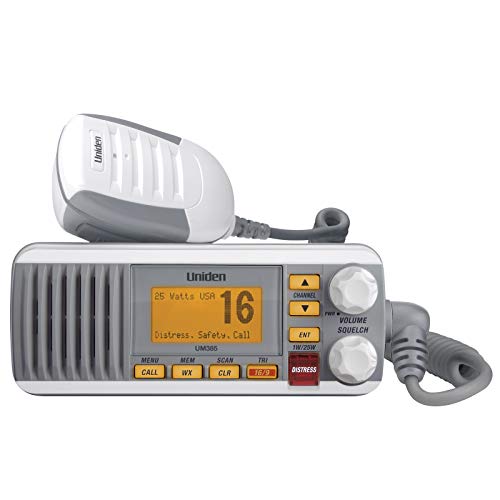
A DSC distress button at the helm
Uniden UM385 Fixed-Mount VHF with DSC
From the listing · not testedBuy it if your boat has no DSC radio and you want one-button distress.
Pros
- + Full Class D DSC with distress button, position send and request, per Uniden
- + 25 W fixed-mount radio with triple watch and weather alerts
Cons
- - Needs a boat to mount on, an antenna and 12 V power; IPX4, splash only
Frequently Asked Questions
Can I use my handheld VHF on land?
Not as a ship radio. The FCC's handheld page lists a separate Coast Station Handheld license for use "primarily on land," and says that when such a radio is used on the water it must follow the rules for ship radios.
Which channel do I call for help on?
Channel 16. The Coast Guard's radio page says Mayday calls go on 16, and your call should give your position, the nature of the distress, the help you need and the number of people aboard.
Do I need a separate MMSI for a handheld?
The FCC says each vessel needs only one MMSI, but it offers a handheld-formatted MMSI for a DSC handheld used on several vessels, requested on FCC Form 605 as a portable license.
Proof
Sources
Everything this guide relies on, as linked in the text. Last checked September 30, 2026.
- U.S. Coast Guard Navigation Center: Radio information for boaters
- Federal Communications Commission: VHF handheld page
- Federal Communications Commission: MMSI page
- boatus.com: boatus.com page
- U.S. Coast Guard Navigation Center: MMSI guidance
- Federal Communications Commission: Ship radio stations
- U.S. Consumer Product Safety Commission: CPSC recall notices
SaltProofLab is a participant in the Amazon Services LLC Associates Program, an affiliate advertising program designed to provide a means for sites to earn advertising fees by advertising and linking to Amazon.com.
Amazon prices and availability change often; cards with a live Amazon price show when it was last checked. As an Amazon Associate I earn from qualifying purchases.